Five days. Four riders. One route. The premise was simple: gravel bikes, minimal bags
Everything else we figured out on the road.
The route
We started in Jaca, on the Spanish side, and finished in Saint-Gaudens, on the French side. Five days, roughly 420km, somewhere around 9,000m of elevation gain depending on which GPS you believed. We stopped believing them after day two.
The route wasn't pre-planned in detail — we had a general corridor and a list of passes we wanted to cross. Everything else was negotiable. This turned out to be the right approach.
The Pyrenees don't reward rigid itineraries. Weather changes fast, passes close without warning, and the best stops are always the ones you didn't plan.
Day 1 — Jaca to Hecho
78km · 1,800m
We left Jaca at 7am in fog that didn't lift until noon. The climb out of the valley on gravel was slow and quiet — the kind of silence that takes thirty minutes to settle into after a week at a desk.
The valley of Hecho is where you understand what the Pyrenees actually are. Not a mountain range you cross. A world you enter. The village has one bar, one small hotel, and a woman who sells homemade cheese from her front door. We bought more than we needed and ate it on a wall in the afternoon sun.
What we carried that day: too much. The "emergency" dry bag with a second waterproof jacket weighed 800g and stayed sealed for five days.
Day 2 — Hecho to Gavarnie (France)
92km · 2,400m
The border crossing on a gravel bike is not marked. You cross it somewhere on a high plateau that looks the same on both sides. The difference is the road surface — French gravel is smoother, which sounds like a stereotype until you feel it.
Gavarnie is a circus in July. In late April, it's almost empty. The cirque at the end of the valley still has snow and the waterfall is at full volume. We ate dinner at the only restaurant open and slept nine hours.
Day two is where trips like this get decided. Everyone's legs are still adapting, the weight of the bags is still unfamiliar, and the question of whether this was a good idea is still open. By Gavarnie, we had our answer.
What we left behind (mentally): the idea that every day needed to be an achievement. Day two was slow. It was the best day.
Day 3 — Gavarnie to Arreau
65km · 1,600m
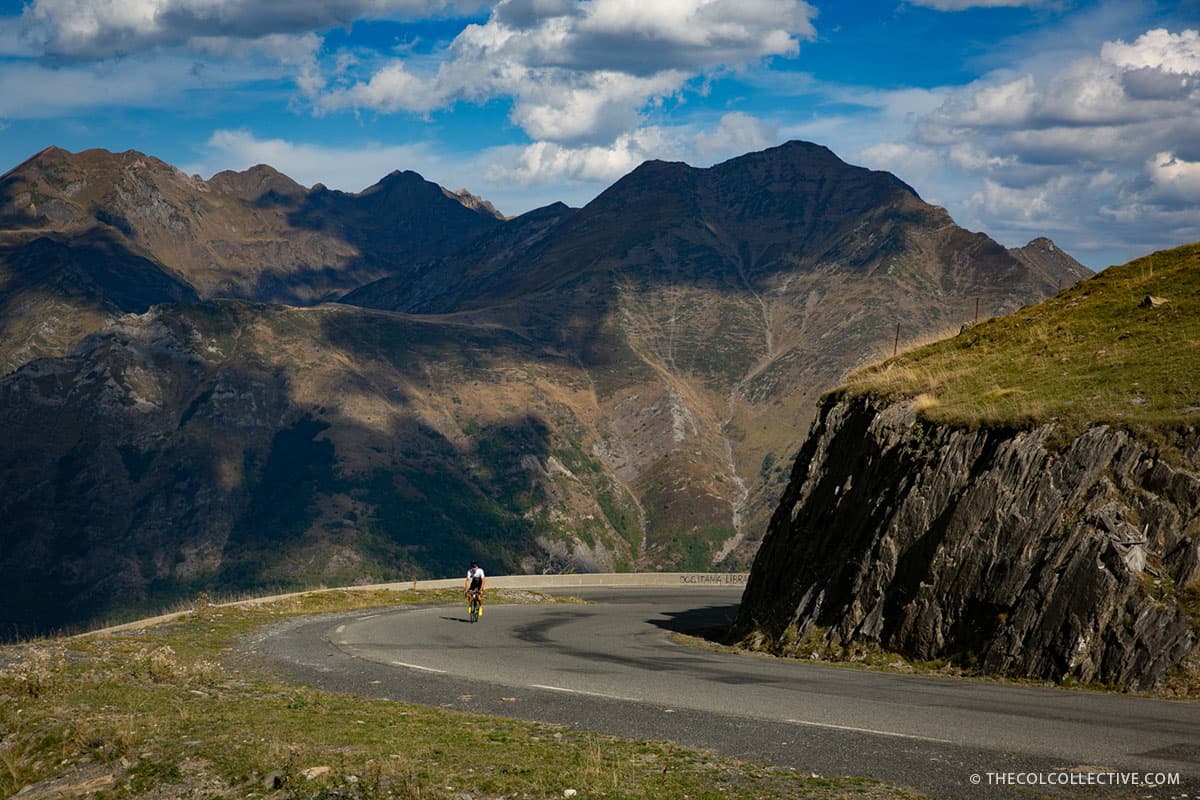
The shortest day by distance, the longest by effort. The Col de Boucharo in the morning is 2,270m of altitude and a surface that rewards 42mm tyres and punishes everything else. We had 40mm. We managed.
Arreau is a proper Pyrenean town — market on Wednesday, bakery that opens at 6:30, a river that runs through the centre loud enough to hear from your bed. We arrived at 2pm and did nothing for four hours. This was not wasted time.
The rule we established by day three: if there's a bakery, stop. Always. The extra ten minutes never cost us anything important.
Day 4 — Arreau to Bagnères-de-Luchon
88km · 2,100m
The Peyresourde is a Tour de France climb that you can ride on gravel if you know the alternative route on the eastern side. It adds two kilometres and removes the tarmac entirely. Worth it completely.
The descent to Luchon on a loaded bike at the end of a long day requires respect. We gave it respect. Luchon has thermal baths, which we used for ninety minutes, and a market that was setting up as we arrived in the late afternoon. We ate standing up at a charcuterie stall and felt like we'd earned it.
What we left behind (physically): Alex's portable espresso maker, somewhere between Arreau and the Peyresourde. A loss mourned briefly and then forgotten.
Day 5 — Luchon to Saint-Gaudens
97km · 1,200m
The last day is always strange. You're strong enough to push hard and sentimental enough not to want it to end. We compromised and rode at a pace that let us notice things.
The descent from the hills to the plain of the Garonne is one of those landscape transitions that happens all at once — one moment you're in mountain terrain, the next you're looking at a horizon for the first time in five days. The city feels far away and then suddenly close.
We reached Saint-Gaudens at 3pm. Train at 5:15. Coffee, pastry, and a conversation about which pass was the hardest (Boucharo, unanimously) and which day was the best (day two, also unanimously).
What we brought that mattered
The bike — A gravel bike with mounts for two bottle cages and a frame bag. Nothing more exotic than that. Wider tyres make everything better. If you're choosing between 38mm and 42mm, choose 42mm.
Sleeping — Two nights camping, three nights in small hotels or gîtes booked the night before. The camping nights were the coldest and the best. A lightweight sleeping bag rated to 5°C is enough for late April in the Pyrenees if you wear your kit inside it.
Food — We bought food every day in whatever village we stopped in. No energy gels, no packaged bars. Bread, cheese, dried fruit, chocolate, and whatever the bakery had. This turned out to be both cheaper and better than any food system we'd planned.
Navigation — GPX routes downloaded offline on two phones. When one died on day three, the other had everything. Paper map as backup, used once on day four when we took a track that wasn't on either GPS.
What we left behind
The stuff we didn't use — one full change of casual clothes, a portable battery that added 300g to save a phone charge we could have done at the hotel, two books (we read zero pages), a multi-tool with seventeen functions (used the tyre lever and two allen keys).
The stuff we wish we'd left — the idea that we needed a plan. The best moments of the trip — the cheese wall in Hecho, the thermal baths in Luchon, the wrong track on day four that led to a valley we hadn't seen on any map — none of them were planned.
The rule — if you haven't used it in the first two days, you don't need it. Find a post office and send it home.
The stops that saved us
The bar in Hecho that opened at 7am and served coffee in bowls. The bakery in Arreau that had pain au chocolat at 6:30. The charcuterie stall in Luchon. The single vending machine at the top of the Peyresourde that had cold Coca-Cola and we still can't explain why it was there but we were glad it was.
All confirmed stops are listed on the Ravito map with opening hours and what to order.
Would we do it again
Yes. Shorter on the gear, longer on the route. There's a version of this trip that goes from Hendaye to Banyuls — the full traverse, twenty days, sea to sea. That's the next conversation.
For now: the Pyrenees in five days is enough to change how you think about what a weekend ride can be. Start from Jaca. Leave early. Stop when you find cheese.
GPX files for all five daily stages are available on the Ravito map. The route is marked as "Pyrenees 5-Day" under Gravel routes.